

Most travelers passing through Brazil on a connecting flight do not need a separate transit visa if they remain in the international transit area of the airport. However, US, Canadian, and Australian citizens must obtain a Brazil eVisa – which covers transit – before departure, even if they never leave the airside zone. This guide explains exactly who needs a transit visa, who is exempt, and how to apply step by step.
What Is a Brazil Transit Visa?
A Brazil transit visa is a short-stay visa that allows travelers to pass through Brazilian territory en route to a final destination in another country. It does not authorize tourism, business activities, or employment in Brazil – only the act of transiting through the country. The transit visa falls under Brazil’s VIVIS (short-term visitor) category and is governed by the Brazilian Ministry of Foreign Affairs (MRE).
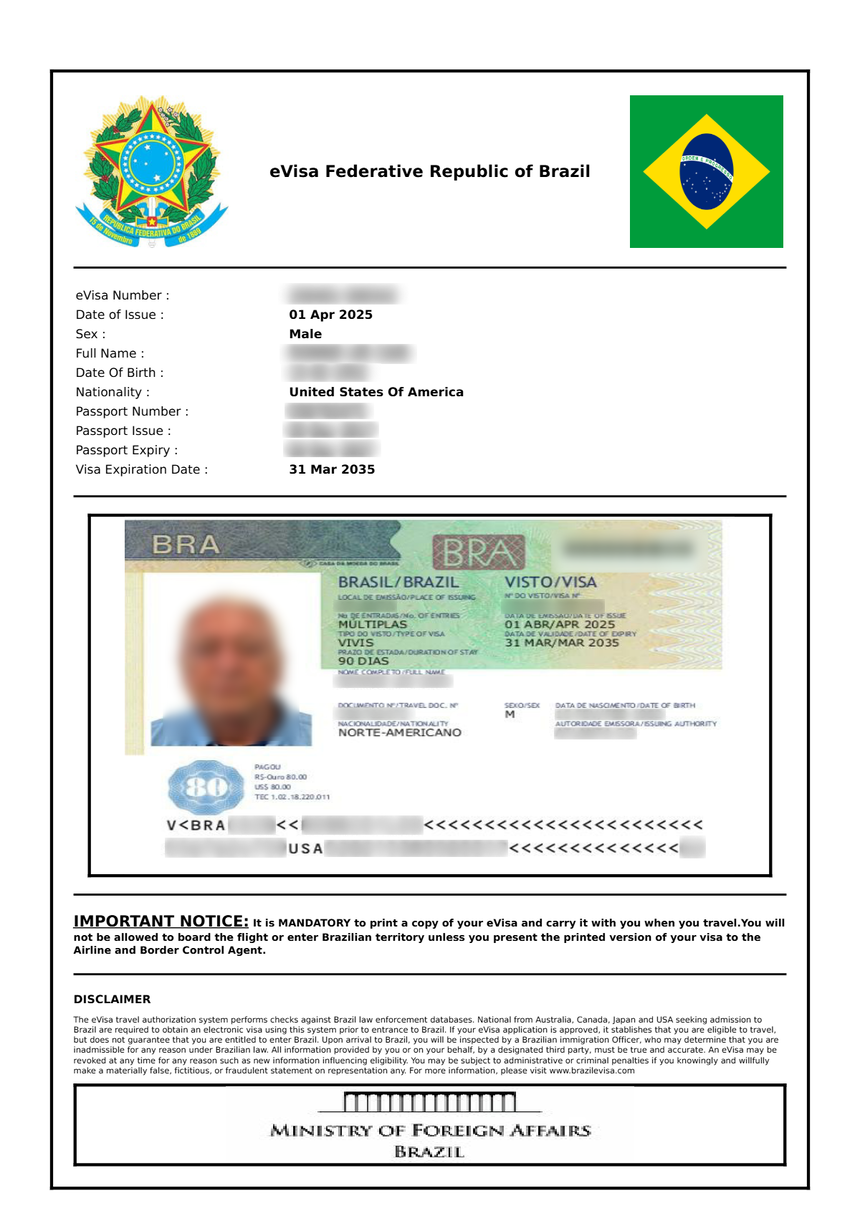
The Brazil transit visa is required only for citizens of countries that do not have visa-free or visa-on-arrival agreements with Brazil. For US, Canadian, and Australian citizens, the standard eVisa – which costs $80.90 and covers transit as an authorized purpose of travel – serves the same function as a dedicated transit visa.
Key Differences: Transit Visa vs. Tourist Visa vs. eVisa
| Feature | Transit Visa | Tourist Visa (eVisa) | Consular Tourist Visa |
|---|---|---|---|
| Purpose | Connecting flights only | Tourism, business, transit | Tourism, business, transit |
| Stay allowed | Up to 10 days | Up to 90 days | Up to 90 days |
| Eligible nationalities | Non-visa-free countries | US, Canada, Australia | All nationalities |
| Application method | Consulate only | Online at brazil.vfsevisa.com | Consulate |
| Fee | $40-$80 USD | $80.90 USD | Varies by nationality |
| Processing time | 1-2 weeks | Up to 10 business days | 1-3 weeks |
| Leave airport? | No (airside only) | Yes | Yes |
Important: If your nationality qualifies for the Brazil eVisa (US, Canada, Australia), you do not need a standalone transit visa. The eVisa covers transit and is more flexible since it also permits entry into Brazil for tourism and business.
Who Needs a Transit Visa for Brazil?
Citizens of countries that are not visa-exempt and are not eligible for the Brazil eVisa need a transit visa when connecting through a Brazilian airport. Whether you need a transit visa depends on three factors: your nationality, whether you will leave the international transit area, and how long your connection is.
Nationalities That Need a Transit Visa
Brazil’s transit visa requirement applies to citizens of countries that have visa reciprocity agreements with Brazil. The list is maintained by the MRE and includes but is not limited to:
- Afghanistan, Bangladesh, Pakistan, Sri Lanka – Transit visa required
- China (PRC) – Transit visa required (5-day visa-free for direct transit in some cases)
- India – Transit visa required for connections exceeding the airside exemption period
- Nigeria, Ghana, Ethiopia – Transit visa required
- Cuba, Haiti – Transit visa required
- Other non-visa-free countries – Check with the nearest Brazilian consulate
US, Canadian, and Australian citizens do not need a standalone transit visa. They can use the Brazil eVisa to transit through Brazil. The eVisa costs $80.90, is valid for up to 10 years, and permits stays of up to 90 days per visit – far exceeding the typical transit connection time.
Who Is Exempt from a Brazil Transit Visa?
Citizens of the following categories do not need a transit visa:
- Visa-free nationalities – Citizens of over 80 countries including all EU member states, the United Kingdom, Japan, South Korea, Argentina, Chile, Colombia, and other Mercosur/Mercosul states
- eVisa-eligible nationalities – US, Canadian, and Australian citizens (use the eVisa for transit)
- Holders of valid Brazilian visas – Any valid visa (tourist, business, work) permits transit
- Airside passengers with through tickets – If you remain in the international transit zone, do not collect checked luggage, and your connection is on the same ticket (some nationalities still need a visa – check before travel)
The Airside Transit Exception
Brazil does not have a blanket airside transit exemption for all nationalities. Unlike some countries that allow visa-free airside transit for all passengers, Brazil requires a visa (transit visa, eVisa, or other valid visa) for citizens of countries on the visa-required list, even if they never leave the airport’s international transit area.
This means that a Nigerian or Indian citizen connecting through São Paulo Guarulhos (GRU) on a single ticket – with no intention of leaving the airport – still needs either a transit visa or a valid Brazilian visa to board the connecting flight.
Exception: Citizens of certain countries may qualify for a limited airside exemption if their connection is less than 12 hours, they hold a confirmed onward ticket, and they do not leave the transit zone. This exemption is not guaranteed and varies by airport and airline. Always confirm with your airline before travel.
How to Apply for a Brazil Transit Visa
The Brazil transit visa application is submitted through the Brazilian consulate or embassy in your country of residence, or through Brazil’s online visa portal if you are eligible for the eVisa. The process varies depending on your nationality.
Option 1: Brazil eVisa (for US, Canadian, and Australian Citizens)
If you hold a US, Canadian, or Australian passport, the eVisa is the simplest way to transit through Brazil:
- Visit brazil.vfsevisa.com – Create an account with your email address
- Complete the online application form – Enter personal details, passport information, and travel dates. Select “Transit” as your purpose of travel
- Upload your documents – Passport biographical page scan (JPEG or PNG, minimum 600 x 600 pixels), passport-style photograph (2×2 inches, white background), and proof of immigration status if applicable
- Pay the fee – $80.90 USD by credit or debit card. The fee is non-refundable
- Wait for processing – Standard processing takes up to 10 business days. During peak travel seasons (December-February, June-July), it may take longer
- Download your eVisa – Once approved, download and print the eVisa approval to carry with your passport
The eVisa is valid for up to 10 years with multiple entries, making it a better long-term investment than a single-use transit visa if you plan to transit through Brazil more than once.
Option 2: Consular Transit Visa (for Other Nationalities)
If you are not eligible for the eVisa, apply at the Brazilian consulate or embassy in your country of residence:
- Contact your nearest Brazilian consulate – Confirm requirements specific to your nationality, as some consulates have additional documentation requirements
- Gather required documents:
- Valid passport – At least 6 months remaining validity from your planned transit date
- Passport photographs – 2 photos, 2×2 inches, white background
- Onward flight ticket – Confirmed booking to your final destination within 10 days
- Visa for final destination – If required by the country you are traveling to
- Completed application form – Available at the consulate or downloadable from the MRE website
- Submit your application in person – Most consulates require an in-person visit. Some accept applications by mail
- Pay the consular fee – $40-$80 USD depending on your nationality and the consulate
- Wait for processing – Consular transit visa processing typically takes 1-2 weeks
Key rule: Transit visa holders cannot leave the international transit area of the airport. If you need to collect and re-check luggage, exit the airport, or have a connection that requires you to pass through Brazilian immigration, you need a full tourist or entry visa – not a transit visa.
Brazil Transit Visa Documents
The document requirements for a Brazil transit visa are lighter than for a tourist or business visa. You do not need proof of accommodation, bank statements, or an employer letter. The focus is on your identity, your onward travel, and your authorization to enter the final destination country.
Complete Document Checklist
| Document | Specifications |
|---|---|
| Valid passport | At least 6 months remaining validity, 2 blank visa pages, no damage |
| Passport photographs | 2 photos, 2×2 inches (51x51mm), white background, neutral expression, taken within 6 months |
| Onward flight ticket | Confirmed booking showing departure from Brazil within 10 days of arrival |
| Visa for final destination | If required – must be valid for entry into your destination country |
| Completed application form | Available at the Brazilian consulate or MRE website |
| Previous Brazilian visas (if any) | Copies of any previously issued Brazilian visas |
What You Do NOT Need for a Transit Visa
- Bank statements or proof of financial means (unlike tourist visas)
- Hotel reservation or proof of accommodation
- Employment letter or invitation from a Brazilian company
- Travel insurance (recommended but not mandatory)
- Criminal background check (required only for long-term visas)
Document Upload and Format Requirements
For online eVisa applications (US, Canadian, Australian citizens):
- Passport scan: JPEG or PNG, minimum 600 x 600 pixels, all four corners visible, MRZ code legible
- Photo: JPEG or PNG, 2×2 inches, white background, no glasses with tinted lenses
- File size: Under 2 MB per document
- Color: Full color only – no black-and-white scans
For consular applications: Bring original documents and photocopies. The consulate will return originals after verification.
Brazil Transit Visa Processing Time and Validity
The Brazil transit visa processes faster than most other Brazilian visa types due to its limited purpose and short validity. However, processing times vary by application method and consulate workload.
Processing Times by Application Type
| Application Type | Processing Time | Validity | Maximum Stay |
|---|---|---|---|
| eVisa (online) | Up to 10 business days | 10 years, multiple entry | 90 days per visit |
| Consular transit visa | 1-2 weeks | Typically 90 days from issue | 10 days |
| Express processing (where available) | 3-5 business days | Same as standard | Same as standard |
How Long Is the Transit Visa Valid?
- Consular transit visa: Valid for a single entry within 90 days of issuance. Maximum stay in Brazil is 10 days from the date of entry
- eVisa for transit: Valid for up to 10 years with multiple entries. Each stay can last up to 90 days, though transit connections are typically hours, not days
Can You Extend a Transit Visa?
No. The Brazil transit visa cannot be extended. If you need to stay in Brazil longer than 10 days – for example, due to a missed connection, flight cancellation, or emergency – you must visit a Policia Federal (Federal Police) office at the airport to request a change of immigration status or obtain an emergency visa extension.
If you overstay a transit visa, you may face:
- A daily fine assessed by the Federal Police upon departure
- A potential re-entry ban to Brazil
- Difficulty obtaining future visas
Which Brazilian Airports Handle Transit Passengers?
Brazil has several major international airports that handle transit passengers, with São Paulo Guarulhos (GRU) being the largest transit hub. Understanding the airport layout and transit procedures helps ensure a smooth connection.
Major Transit Airports in Brazil
| Airport | Code | City | Transit Facilities |
|---|---|---|---|
| São Paulo Guarulhos | GRU | São Paulo | Largest hub, Terminals 2 and 3 handle international transit, minimum 2-hour connection recommended |
| Rio de Janeiro Galeão | GIG | Rio de Janeiro | Terminal 1 international transit, connections to South America and Europe |
| Brasília | BSB | Brasília | Limited international transit, mostly domestic connections |
| Recife | REC | Recife | Northeast Brazil hub, connections to Europe and the Americas |
| Fortaleza | FOR | Fortease | Growing international hub, direct flights to Europe |
Transit Procedures at GRU (São Paulo)
São Paulo Guarulhos Airport (GRU) is the most common transit point for passengers connecting through Brazil. Here is what to expect:
- Arrival: Disembark and follow signs for “International Connecting Flights” or “Trânsito Internacional”
- Security screening: Pass through a security checkpoint for transit passengers (no immigration required if staying airside)
- Transfer to gate: GRU has airside bus transfers between terminals – allow extra time for Terminal 2 to Terminal 3 transfers
- Boarding: Proceed to your departure gate for your connecting flight
Important: If your luggage is not checked through to your final destination (separate tickets), you must clear immigration, collect your bags, and re-check them. This requires a visa that permits entry into Brazil – a transit visa alone is not sufficient for this scenario.
Minimum Connection Times
- Same terminal: 90 minutes minimum recommended
- Different terminals (GRU): 2-3 hours minimum – airside transfers between terminals can take 30-45 minutes
- Separate tickets: 4+ hours – you must clear immigration, collect luggage, re-check, and clear security
Brazil Transit Visa for Specific Nationalities
Transit visa requirements and processes differ by nationality. Below are details for the most common transit nationalities passing through Brazil.
Transit Visa for Indian Citizens
Indian passport holders need a transit visa to pass through Brazil, even for airside connections. Options include:
- Consular transit visa: Apply at the Brazilian Embassy in New Delhi or consulates in Mumbai or other cities. Processing takes 1-2 weeks, fee is approximately $40-$80 USD
- eVisa: Indian citizens are not eligible for the Brazil eVisa (only US, Canada, Australia)
- Airside exemption: Not guaranteed for Indian citizens. Confirm with your airline before booking
Transit Visa for Chinese Citizens
Chinese (PRC) passport holders need a transit visa for connections through Brazil. However, Brazil has occasionally offered 72-hour or 5-day visa-free transit for Chinese citizens at select airports under specific conditions:
- Must hold a confirmed onward ticket to a third country
- Connection must be within the allowed time frame
- Must remain in the international transit area or designated zone
These exemptions are not permanent policies and can be suspended without notice. Always verify current rules with the Brazilian consulate or your airline before travel.
Transit Visa for Nigerian and Other African Citizens
Citizens of most African nations – including Nigeria, Ghana, Ethiopia, Kenya, and South Africa – need a transit visa for Brazil. Apply at the nearest Brazilian embassy or consulate with:
- Valid passport with 6 months remaining validity
- 2 passport photos (2×2 inches, white background)
- Confirmed onward ticket within 10 days
- Visa for your final destination (if required)
- Processing time: 1-3 weeks depending on the consulate
Transit Visa for Haitian Citizens
Haitian passport holders need a transit visa for Brazil. Given the limited Brazilian consular presence in Haiti, applicants may need to apply at the Brazilian Embassy in a neighboring country (such as the Dominican Republic or Colombia). Processing times vary and can take 2-4 weeks.
Common Problems with Brazil Transit (and How to Avoid Them)
Transit issues at Brazilian airports most often stem from visa misunderstandings, tight connections, and separate-ticket bookings. Knowing these pitfalls in advance prevents missed flights and denied boarding.
Top 5 Transit Problems
-
No visa for airside transit – Airlines deny boarding at your origin if you lack a valid Brazilian visa, even if you are only transiting. Always confirm visa requirements before booking. Airlines check visas at check-in and will not let you board without one
-
Separate tickets requiring immigration clearance – If you booked two separate tickets (e.g., one airline to GRU, another from GRU to your destination), you must clear immigration and re-check luggage. A transit visa is not enough – you need a visa that permits full entry
-
Missed connections due to short layovers – GRU transfers between terminals can take 30-45 minutes by airside bus. Connections under 2 hours between different terminals are risky. Book connections with at least 2-3 hours of buffer
-
Overstaying the 10-day transit limit – If your connecting flight is cancelled or delayed beyond 10 days, visit the Policia Federal office at the airport immediately. Do not wait until your visa expires
-
Wrong visa type – Using a transit visa when you need a tourist visa (or vice versa) can cause problems at immigration. If you plan to leave the airport for any reason – even a long layover city tour – you need a tourist visa, not a transit visa
What to Do If Your Flight Is Cancelled During Transit
If you are stuck in Brazil due to a cancelled or delayed connecting flight:
- Contact your airline immediately – They are responsible for rebooking and may provide hotel accommodation
- Do not leave the transit area unless instructed by airline staff or immigration officials
- If you must leave the airport, visit the Policia Federal desk to regularize your immigration status
- Keep all documentation – Boarding passes, cancellation notices, and rebooking confirmations
- Check your transit visa validity – If your stay exceeds the allowed period, Federal Police can issue a temporary extension
FAQs About Brazil Transit Visa
Do US citizens need a transit visa for Brazil?
US citizens do not need a separate transit visa. The Brazil eVisa ($80.90, valid for up to 10 years) covers transit as an authorized purpose. Apply online at brazil.vfsevisa.com. Even for a short airport connection, US citizens need a valid Brazilian visa to board flights transiting through Brazil.
Can I leave the airport during a layover in Brazil?
Only if you hold a visa that permits entry into Brazil (such as the eVisa or a tourist visa). A transit visa does not authorize you to leave the international transit area. If you want to explore during a long layover, you need a full tourist visa, not a transit visa.
How long can I stay in Brazil on a transit visa?
A consular transit visa allows a maximum stay of 10 days. The Brazil eVisa (for US, Canadian, and Australian citizens) allows up to 90 days per visit, which covers any transit scenario. Transit connections are typically measured in hours, but the visa validity gives you a buffer for delays.
How much does a Brazil transit visa cost?
A consular transit visa costs $40-$80 USD depending on your nationality and the consulate. The Brazil eVisa for US, Canadian, and Australian citizens costs $80.90 USD and covers transit plus tourism and business. The eVisa is valid for up to 10 years, making it more cost-effective for frequent travelers.
Do I need a transit visa if I am not leaving the airport?
It depends on your nationality. Citizens of visa-free countries (EU, UK, Japan, and others) do not need any visa for airside transit. Citizens of visa-required countries (India, China, Nigeria, and others) need a valid Brazilian visa even for airside transit. US, Canadian, and Australian citizens need the eVisa.
How long does it take to get a Brazil transit visa?
A consular transit visa takes 1-2 weeks to process. The Brazil eVisa takes up to 10 business days. During peak travel seasons (December-February, June-July), both may take longer. Apply at least 3-4 weeks before your travel date to account for delays.
Can I transit through Brazil on two separate tickets?
Yes, but you will need to clear Brazilian immigration to collect and re-check your luggage. This requires a visa that permits entry into Brazil – a transit visa alone is not sufficient. If you are on separate tickets, apply for a tourist visa or eVisa instead of a transit visa.
Do children need a transit visa for Brazil?
Yes. Every traveler, regardless of age, needs their own visa for Brazil. Children and infants transiting through Brazil need either a transit visa or an eVisa, depending on the child’s nationality. Each application requires the child’s own passport and photos, plus parental consent documents if traveling with one parent.
Is a Brazil transit visa single or multiple entry?
A consular transit visa is typically single-entry, valid for one transit within 90 days of issuance. The Brazil eVisa allows multiple entries during its 10-year validity period, making it suitable for travelers who transit through Brazil regularly.
What happens if I overstay my transit visa in Brazil?
Overstaying a transit visa results in a daily fine assessed by the Federal Police upon departure. Extended overstays can lead to a re-entry ban and difficulty obtaining future visas. If your flight is cancelled or delayed beyond your visa validity, visit the Policia Federal office at the airport immediately to regularize your status.