

The Brazil work visa (VITEM V) is the mandatory permit for foreign nationals seeking paid employment in Brazil. Unlike the business eVisa for short-term meetings, the VITEM V requires employer sponsorship from a Brazilian company, approval from the Ministry of Labor, and a consular application in your home country. This guide covers every VITEM V category, requirement, document, and step for US, Canadian, Australian, and other foreign workers planning to work legally in Brazil.
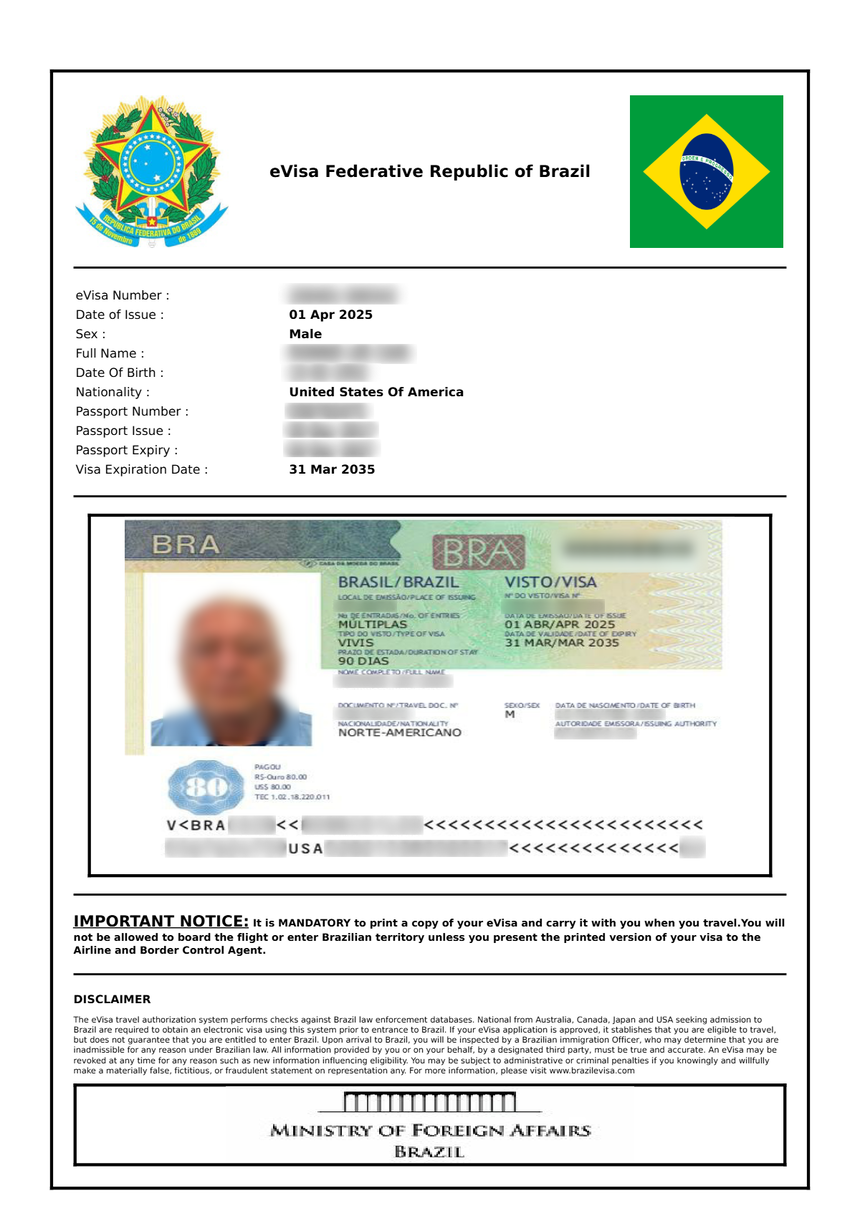
What Is the Brazil Work Visa (VITEM V)?
The VITEM V is Brazil’s official work visa that permits foreign nationals to engage in paid employment or professional activities in Brazil with employer sponsorship. It is regulated by the Brazilian Ministry of Labor and Employment (MTE) and the National Immigration Council (CNIg). Unlike visitor visas, the VITEM V allows you to receive salary, sign employment contracts, and reside in Brazil for the duration of your work contract.
Brazil classifies all temporary visas under the VITEM system. The VITEM V specifically covers:
- Formal employment with a Brazilian company
- Technical services and specialized expertise
- Transfer of technology and knowledge-sharing assignments
- Professional sports and cultural activities with paid contracts
- Maritime and offshore work on Brazilian-flagged vessels
- Academic and research positions at Brazilian institutions
Key Features of the VITEM V
| Feature | Details |
|---|---|
| Visa type | Temporary work visa (VITEM V) |
| Duration | Up to 2 years, renewable |
| Employer sponsorship | Required from a Brazilian entity |
| Application method | Brazilian consulate in your country |
| Ministry approval | Required from MTE before consular processing |
| Work authorization | Full employment and salary permitted |
| Family inclusion | Dependents can apply for VITEM V derivative visas |
Who Needs a Brazil Work Visa?
Any foreign national who intends to work, receive payment, or engage in professional activities in Brazil needs a VITEM V work visa, regardless of their nationality or the duration of employment. There are no nationality-based exemptions for work authorization in Brazil.
Situations That Require a VITEM V
- You have received a job offer from a Brazilian employer
- Your current company is transferring you to a Brazilian branch
- You will provide specialized technical services to a Brazilian company
- You signed a professional sports contract with a Brazilian club
- You will conduct paid research or academic work at a Brazilian institution
- You are a maritime worker on a Brazilian vessel or offshore platform
Situations That Do NOT Require a VITEM V
- Attending business meetings or conferences (use VIVIS eVisa)
- Tourism or visiting family (use VIVIS eVisa or visa-free entry for eligible nationalities)
- Remote work for a foreign employer while visiting Brazil (gray area – consult an attorney)
- Volunteer work without payment from a Brazilian source
Critical distinction: If you receive any payment, salary, or compensation from a Brazilian source, you MUST have a VITEM V. Working on a tourist visa or business visa is illegal under Brazilian law and can result in fines, deportation, and a multi-year entry ban.
Types of Brazil Work Visas
Brazil issues several VITEM V subcategories, each designed for a specific type of work activity. The most common are the VITEM V for regular employment and the VITEM V for technical services. Your employer’s legal team should determine which subcategory applies to your situation.
VITEM V Categories
| Category | Description | Duration | Typical Profile |
|---|---|---|---|
| VITEM V – Employment | Standard employment with a Brazilian company | Up to 2 years | Hired employees, managers |
| VITEM V – Technical | Technical assistance or specialized services | Up to 1 year | Technicians, consultants |
| VITEM V – Technology Transfer | Transfer of knowledge or technology | Up to 2 years | Engineers, researchers |
| VITEM V – Maritime | Work on Brazilian vessels or platforms | Up to 2 years | Seafarers, offshore workers |
| VITEM V – Sports | Professional sports contracts | Up to 2 years | Athletes, coaches |
| VITEM V – Academic | Teaching or research positions | Up to 2 years | Professors, researchers |
VITEM V vs. VIVIS: When to Use Which
| Activity | VIVIS (eVisa) | VITEM V |
|---|---|---|
| Business meetings | Yes | Yes |
| Conferences | Yes | Yes |
| Employment | No | Yes |
| Receiving a salary | No | Yes |
| Signing an employment contract | No | Yes |
| Technical training (as trainer) | Yes (up to 90 days) | Yes |
| Duration | Up to 90 days | Up to 2 years |
| Application | Online | Consulate only |
Brazil Work Visa Requirements
To obtain a VITEM V work visa, your Brazilian employer must first secure authorization from the Ministry of Labor and Employment (MTE), after which you submit your application at a Brazilian consulate with a set of personal and professional documents. The process has two distinct phases: employer-side and employee-side.
Employer Requirements (Brazilian Company)
Your Brazilian employer must fulfill these obligations before you can apply:
- CNPJ registration – The company must be registered with a valid CNPJ (Cadastro Nacional de Pessoa Juridica)
- Work permit application – Filed with the Ministry of Labor (MTE) via the SINTER system
- Justification letter – Explaining why a foreign worker is needed and why no Brazilian worker can fill the position
- Employment contract – Drafted in compliance with Brazilian labor laws (CLT – Consolodacao das Leis do Trabalho)
- Company financial documentation – Proving the company can afford the foreign worker’s salary
- Social security compliance – Proof that the company is current on INSS (social security) payments
Employee Requirements (Foreign Worker)
Once the MTE approves the work permit, you must provide:
- Valid passport with at least 6 months of remaining validity and at least 2 blank pages
- Passport-size photographs – 2×2 inches (51×51 mm), white background, recent (within 6 months)
- Criminal background check – From your country of residence, apostilled or legalized
- Educational credentials – Diplomas, degrees, and professional certifications, apostilled or legalized
- Medical certificate – Proving you are in good health (some consulates require specific examinations)
- Approved work permit – The MTE authorization obtained by your employer
- Signed employment contract – In Portuguese, with all terms matching the MTE filing
- Completed visa application form – Filled out on the MRE (Ministry of Foreign Affairs) portal
- Visa fee payment – Amount varies by nationality and consulate (typically $100-200 USD)
Document Legalization
Documents issued outside Brazil must go through one of these legalization processes:
- Apostille – For countries that are members of the Hague Apostille Convention (US, UK, Australia, most of the EU)
- Consular legalization – For countries not part of the Hague Convention (some documents from Canada until recently)
All foreign documents must be translated into Portuguese by a sworn translator (tradutor juramentado) registered with the Brazilian Commercial Board.
How to Apply for a Brazil Work Visa
The VITEM V application involves your employer filing for work authorization in Brazil first, followed by your personal application at a Brazilian consulate in your country. The entire process typically takes 2-4 months from start to finish.
Step 1: Employer Files Work Permit Application
Your Brazilian employer (or their immigration attorney) must:
- Register on the MTE’s SINTER (Sistema de Trabalho Estrangeiro) platform
- Submit the work permit application with supporting company documents
- Upload the draft employment contract, justification letter, and financial statements
- Pay the applicable MTE processing fee
- Wait for MTE review and approval (typically 30-60 business days)
The MTE reviews whether the position justifies hiring a foreign worker, whether the salary meets minimum requirements, and whether the company is compliant with labor laws.
Step 2: MTE Approval and Notification
Once approved:
- The MTE issues a work permit authorization (autorizacao de trabalho)
- This authorization is electronically transmitted to the Brazilian consulate in your country
- Your employer receives a copy of the authorization to forward to you
Step 3: Employee Applies at the Brazilian Consulate
With the MTE authorization in hand, you must:
- Complete the online visa application form on the MRE portal (vfrfru.mre.gov.br)
- Gather all required documents (passport, photos, background check, credentials, medical certificate)
- Schedule an appointment at the nearest Brazilian consulate
- Attend the appointment in person with all original documents
- Pay the consular visa fee (varies by nationality, typically $100-200 USD)
- Wait for visa processing (typically 10-30 business days after submission)
Step 4: Enter Brazil and Register with Federal Police
After receiving your VITEM V visa:
- Travel to Brazil within the visa validity period
- Register with the Federal Police (Policia Federal) within 30 days of arrival
- Obtain your CRNM (Carteira de Registro Nacional Migratorio) – your foreign resident ID card
- Apply for your CPF (Cadastro de Pessoa Fisica) – your Brazilian tax ID number
- Register with the employer to begin formal employment under CLT
Failure to register with the Federal Police within 30 days can result in fines and complications with your immigration status.
Brazil Work Visa Processing Time
The total processing time for a Brazil work visa ranges from 2 to 4 months, combining the MTE work permit review (30-60 days) and the consular visa processing (10-30 days). Timelines vary based on the consulate, nationality, and completeness of the application.
Processing Timeline Breakdown
| Phase | Duration | Notes |
|---|---|---|
| MTE work permit application | 30-60 business days | Employer-side; depends on completeness |
| MTE approval and notification | 5-10 business days | Transmitted electronically to consulate |
| Consular appointment wait | 1-4 weeks | Depends on consulate availability |
| Visa processing at consulate | 10-30 business days | After document submission |
| Total estimated timeline | 2-4 months | From initial filing to visa in hand |
Factors That Affect Processing Time
- Completeness of application – Missing or incorrect documents cause significant delays
- Consulate workload – Some consulates (Sao Paulo, New York, London) have higher volumes
- Nationality – Some nationalities require additional security checks
- Time of year – Processing slows during Brazilian holidays (Carnival, year-end)
- MTE backlog – Periods of high application volume extend review times
Tips for Faster Processing
- Use an experienced immigration attorney in Brazil to prepare the MTE application
- Prepare all documents in advance – have background checks and apostilles ready before the employer files
- Respond immediately to any requests for additional information from the consulate or MTE
- Ensure the employment contract matches the MTE filing exactly – discrepancies cause rejections
- Schedule the consular appointment as soon as the MTE authorization arrives
Brazil Work Visa Cost and Fees
The total cost of a Brazil work visa includes MTE processing fees, consular visa fees, document legalization, and translation costs, typically ranging from $500 to $1,500 USD. In many cases, the Brazilian employer covers the MTE and legal fees, while the employee covers personal document costs.
Fee Breakdown
| Fee Category | Estimated Cost | Who Pays |
|---|---|---|
| MTE work permit fee | R$100-300 (approx. $20-60 USD) | Employer |
| Consular visa fee | $100-200 USD (varies by nationality) | Employee |
| Document apostille | $20-50 per document | Employee |
| Sworn translation | $30-80 per page | Employee or employer |
| Criminal background check | $20-50 | Employee |
| Medical certificate | $50-150 | Employee |
| Immigration attorney | $1,000-5,000+ (varies by complexity) | Usually employer |
| CRNM registration (Federal Police) | R$204.86 (approx. $40 USD) | Employee |
Additional Costs to Budget For
- Travel costs to the consulate for the in-person appointment
- Travel costs to Brazil (flights, initial accommodation)
- CPF registration – free, but requires in-person visit to Receita Federal
- Health insurance – mandatory for the first months until you enroll in SUS (Brazilian public health system) or get private insurance through your employer
Most reputable Brazilian employers cover the legal fees, MTE filing, and sometimes the consular visa fee as part of the relocation package. Negotiate these terms before the process begins.
Brazil Work Visa Renewal and Extensions
The VITEM V work visa is valid for up to 2 years and can be renewed for additional 2-year periods as long as the employment relationship continues. Renewal applications must be filed before the current visa expires.
Renewal Process
- Employer files a renewal request with the MTE through the SINTER system
- Updated documents are submitted (current employment contract, proof of salary payment, company compliance)
- MTE reviews the renewal (typically faster than the initial application, 15-30 days)
- You register the renewal with the Federal Police to update your CRNM
Permanent Residency Path
After 4 years of continuous legal residence on a VITEM V visa, you may be eligible to apply for permanent residency (visto permanente) in Brazil. Requirements include:
- Continuous legal residence for the qualifying period
- No criminal record in Brazil
- Proof of financial self-sufficiency
- Basic Portuguese language proficiency (in some cases)
Marriage to a Brazilian citizen or having a Brazilian-born child can accelerate the permanent residency timeline.
Common Brazil Work Visa Mistakes to Avoid
Errors in the work visa process can delay your start date by months or result in outright denial. These are the most common mistakes that applicants and employers make.
Top Mistakes
-
Starting work before the visa is approved – Working in Brazil without a valid VITEM V is illegal, regardless of your employer’s urgency. Penalties apply to both the worker and the employer.
-
Using a tourist visa to enter and then applying for work status – You cannot convert a tourist visa to a work visa while in Brazil. You must apply for the VITEM V at a consulate in your home country before entering Brazil for work.
-
Incomplete document legalization – Documents that are not properly apostilled or translated by a sworn translator will be rejected. This adds weeks to the process.
-
Employment contract discrepancies – The contract submitted to the MTE must exactly match what you sign. Differences in salary, position, or terms can void the work permit.
-
Missing the Federal Police registration deadline – You have 30 days from arrival to register. Missing this deadline incurs fines and can complicate future renewals.
-
Not budgeting for translation costs – Every foreign document needs a sworn Portuguese translation. For a typical application with degree, background check, and medical certificate, this can cost $200-500.
-
Assuming the eVisa covers work – The VIVIS eVisa ($80.90) does NOT authorize employment. Even if your employer says “just come on a tourist visa for now,” this is a violation of immigration law.
-
Ignoring the 6-month passport rule – Your passport must have at least 6 months of validity remaining when you apply. Renew before starting the process.
-
Not using an immigration attorney – Brazilian work visa processing involves multiple government agencies and strict procedural requirements. An experienced attorney prevents costly errors.
-
Failing to maintain legal status during renewals – Your VITEM V must be renewed before it expires. Overstaying even by one day can trigger fines and affect future immigration applications.
FAQs About Brazil Work Visa
Can I work in Brazil on a tourist visa or eVisa?
No. The VIVIS eVisa and tourist visas do not authorize employment in Brazil. You must have a VITEM V work visa with employer sponsorship to work legally. Working on a tourist visa can result in fines, deportation, and a ban on future entry.
How long does it take to get a Brazil work visa?
The total process typically takes 2-4 months. The MTE work permit review takes 30-60 business days, followed by 10-30 business days for consular visa processing. Using an experienced immigration attorney and having all documents prepared in advance can shorten the timeline.
Can my family come with me on a VITEM V?
Yes. Your spouse and dependent children (under 18, or under 24 if enrolled in university) can apply for derivative VITEM V visas at the same consulate. They will need their own set of documents (passports, background checks, birth/marriage certificates) translated and legalized.
How much does a Brazil work visa cost?
Total costs range from $500 to $1,500 USD, including consular fees ($100-200), document legalization ($100-300), sworn translations ($200-500), and medical certificates ($50-150). Many employers cover legal and MTE fees as part of the relocation package.
Can I change employers while on a VITEM V?
Changing employers on a VITEM V is complex. Your work visa is tied to the sponsoring employer. To switch employers, your new employer must file a new work permit application with the MTE. In some cases, you may need to leave Brazil and re-apply at a consulate. Consult with an immigration attorney before making any changes.
Do I need to speak Portuguese to get a work visa?
Portuguese language proficiency is not a formal requirement for the VITEM V work visa. However, you will need Portuguese for daily life in Brazil, interactions with government offices, and the Federal Police registration. Some employers require or prefer Portuguese-speaking candidates.
What happens if my work visa application is denied?
If the MTE denies the work permit, the employer can appeal or refile with additional documentation. If the consulate denies the visa after MTE approval, you can address the specific issue (missing document, background check concern) and reapply. Denials are typically due to incomplete documentation rather than substantive issues.
Can I apply for permanent residency through a work visa?
Yes. After 4 years of continuous legal residence on a VITEM V, you may apply for permanent residency. Marriage to a Brazilian citizen or having a Brazilian-born child can shorten this timeline. Permanent residency gives you the right to work for any employer without sponsorship.
Is there a minimum salary requirement for the VITEM V?
The MTE evaluates whether the offered salary is consistent with the position and market rates. For certain categories (such as intracompany transfers), there may be minimum salary thresholds. The employment contract must comply with Brazilian minimum wage laws and applicable collective bargaining agreements.
Can I work remotely from Brazil for a foreign company?
Working remotely from Brazil for a foreign employer is a legally ambiguous area. Brazil does not yet have a specific digital nomad visa category (though proposals exist). Extended remote work from Brazil could be interpreted as taxable activity in Brazil. Consult with both a Brazilian and home-country tax advisor before planning extended remote work stays.