

A Brazil visa’s validity, the number of entries it allows, and the maximum time you can stay per visit are three separate things – and confusing them is the most common reason travelers overstay. Your visa validity is the window during which you can enter Brazil. Your stay limit is how long you can remain inside the country per visit. The number of entries tells you whether you can leave and come back without getting a new visa.
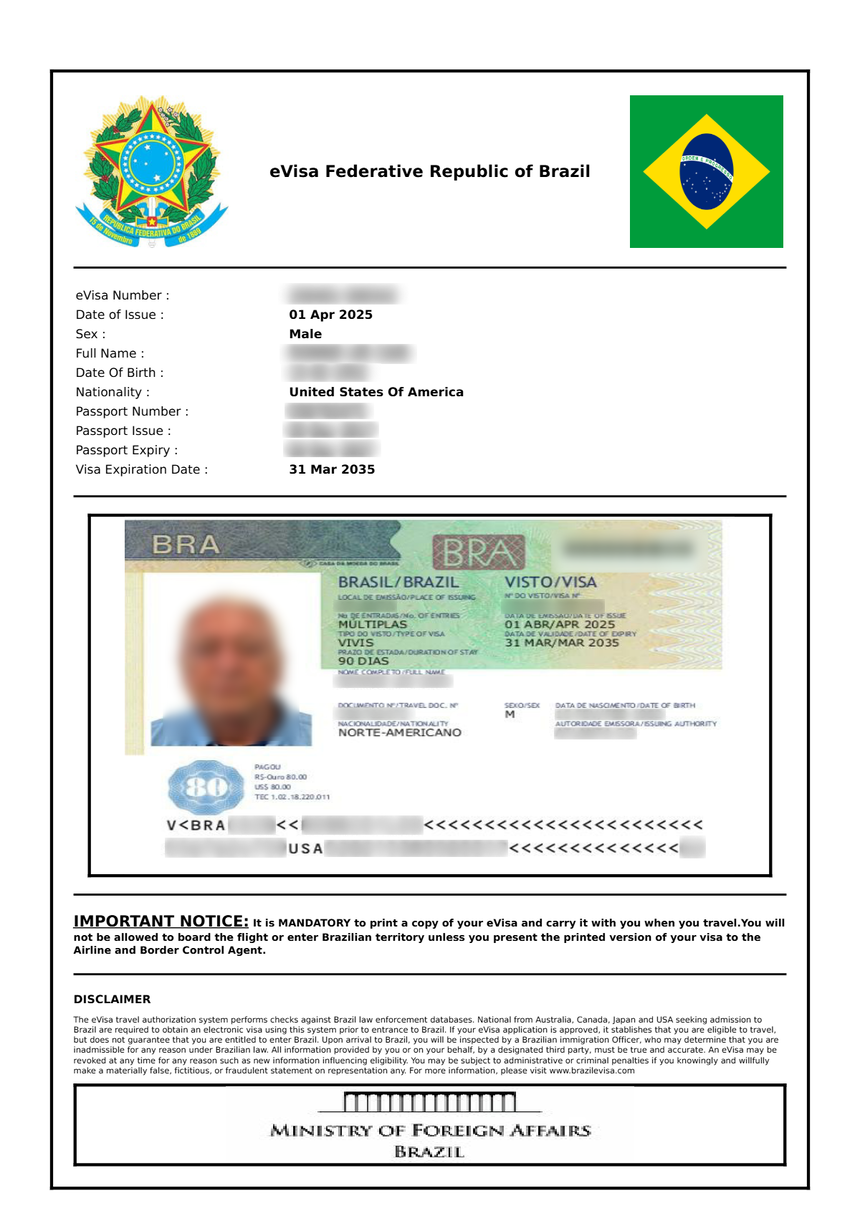
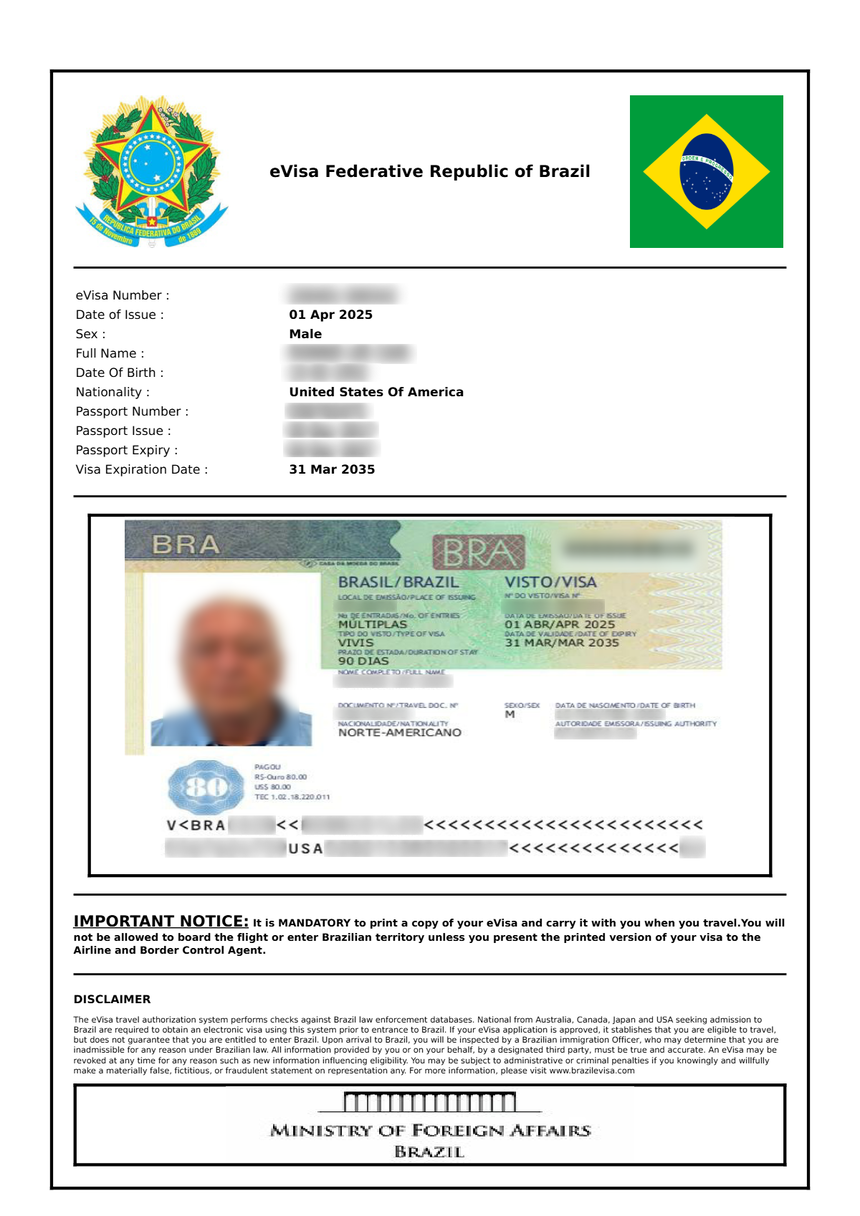
This guide breaks down exactly how validity, entries, and stay limits work for every type of Brazil visa, including the eVisa, consular visas, and visa-free entry.
Understanding Visa Validity vs Stay Duration
Visa validity and stay duration are not the same thing, and mixing them up can lead to serious immigration problems.
Visa validity is the time period during which your visa can be used to enter Brazil. For example, the Brazil eVisa is valid for 10 years. This means you can use it to enter Brazil at any point during that 10-year window.
Stay duration (also called permitted length of stay) is the maximum number of days you can remain in Brazil during a single visit. For most visa types, this is 90 days.
Here is a simple way to think about it: visa validity tells you when you can enter. Stay duration tells you how long you can remain after you enter.
A concrete example: If your eVisa was issued on January 1, 2025, it is valid until January 1, 2035. You can enter Brazil on any date within that window. But once you enter, you can stay for a maximum of 90 days – then you must leave or apply for an extension.
This distinction matters because a visa with 10 years of validity still only allows 90 days of stay per visit. Some travelers assume a long validity period means they can stay for years. It does not.
Brazil eVisa Validity and Entries
The Brazil eVisa, available to citizens of the United States, Canada, and Australia, has the most generous validity of any Brazil visa type.
eVisa key facts:
- Validity: 10 years from the date of issue
- Entries: Multiple (you can enter and leave Brazil as many times as you want during the validity period)
- Maximum stay per visit: 90 days
- Annual stay cap: 180 days total in any rolling 12-month period
- Fee: $80.90 USD
- Processing time: 5-10 business days
The multiple-entry feature is one of the eVisa’s biggest advantages. If you need to visit Brazil several times over a few years – for business, family visits, or extended tourism – you do not need to reapply each time. Your single eVisa covers all entries for the full 10 years.
Important: Your eVisa validity is tied to the passport you used during your application. If your passport expires before the 10-year validity period ends, your eVisa becomes invalid along with it. You would need to apply for a new eVisa with your new passport.
For full application details, see our Brazil eVisa guide.
Consular Visa Validity
If you are not eligible for the eVisa and your country is not visa-exempt, you will need a consular visa from a Brazilian embassy or consulate. Consular visa validity varies by type and nationality.
Tourist visa:
- Validity: Typically 90 days from the date of issue
- Entries: Usually single entry (some nationalities receive multiple entry)
- Maximum stay: 90 days per visit
Business visa:
- Validity: 90 days to 1 year, depending on nationality
- Entries: Single or multiple, depending on nationality and reciprocity agreements
- Maximum stay: 90 days per visit
Transit visa:
- Validity: Shorter period, typically matching your travel itinerary
- Entries: Usually single entry
- Maximum stay: A few days (enough to connect between flights)
The key difference from the eVisa is that consular visas generally have shorter validity and often allow only a single entry. If you leave Brazil and want to return, you may need to apply for a new visa.
Nationality matters. Brazil’s visa policies are based on reciprocity – countries that impose strict requirements on Brazilian citizens receive similar requirements in return. This means a consular visa for an Indian passport holder may differ significantly from one for a Chinese passport holder.
For application steps, see our Brazil visa application guide.
Visa-Free Entry Stay Limits
Citizens of over 100 countries can enter Brazil without a visa for tourism, business, or transit. This includes all EU member states, the United Kingdom, Japan, South Korea, Argentina, and many others.
Visa-free entry rules:
- Maximum stay: 90 days per visit
- Annual cap: 180 days in any rolling 12-month period
- No application required – just show up with a valid passport
- Passport validity: At least 6 months beyond your entry date
Even though no visa is required, the same stay limits apply. You cannot stay in Brazil indefinitely just because you are visa-free. The 90-day per-visit limit and the 180-day annual cap are strictly enforced.
Visa-free travelers should note: When you pass through Brazilian immigration, the officer stamps your passport with your allowed stay period. Always check this stamp – it will show how many days you are permitted to remain. If no date is stamped, ask the officer to confirm your allowed stay.
If you are unsure whether your nationality qualifies for visa-free entry, check our Brazil visa requirements page or the Brazil visa types overview.
The 180-Day Annual Stay Rule
One of the most important – and least understood – rules about Brazil visa validity is the 180-day annual cap. This rule applies to everyone: eVisa holders, consular visa holders, and visa-free visitors.
How it works:
- Your total days in Brazil cannot exceed 180 days in any rolling 12-month period
- This is calculated across all entries, not per visit
- If you enter Brazil three times in a year for 60 days each, you hit the 180-day limit
- Days are counted from your first entry, rolling forward 12 months
Example scenario:
- January 1: Enter Brazil, stay 90 days → leave March 31
- June 1: Re-enter Brazil, stay 60 days → leave July 31
- October 1: Try to re-enter → you have used 150 of your 180 days, so you can stay up to 30 more days until the rolling window resets
Why this matters: Some travelers, especially digital nomads and long-term tourists, assume they can make repeated 90-day visits back-to-back. The 180-day rule prevents this. Once you hit 180 days, you must wait until enough days “fall off” the rolling window before you can re-enter.
There is no way to reset the 180-day clock by leaving and re-entering. The calculation is based on your cumulative presence in Brazil over a rolling 12-month window.
How to Extend Your Stay in Brazil
If you need more than 90 days, you can apply for a stay extension through the Brazilian Federal Police (Polícia Federal).
Extension rules:
- You must apply before your current stay expires – do not wait until the last day
- Extensions of up to 90 additional days may be granted (at the discretion of the Federal Police)
- The total extended stay is still subject to the 180-day annual cap
- You can only extend once per visit
How to apply:
- Visit the nearest Polícia Federal office before your stay expires
- Bring your valid passport
- Bring proof of onward travel or a return ticket
- Bring proof of financial means to support your extended stay
- Pay the extension fee (varies, typically around R$110-R$200)
- Receive a decision – usually within a few business days
Important: An extension is not guaranteed. The Federal Police officer has discretion to approve or deny your request. Having a return ticket and proof of funds increases your chances.
If your extension is denied, you must leave Brazil before your original stay expires to avoid overstay penalties.
Overstay Penalties
Overstaying your visa or permitted stay in Brazil is taken seriously. The consequences include:
Financial penalty:
- A fine of approximately R$100 per day of overstay
- Fines must be paid before you can leave the country
- Payment is typically handled at the airport when departing
Immigration consequences:
- Deportation proceedings may be initiated for significant overstay
- A re-entry ban may be imposed (duration varies based on length of overstay)
- Overstay is recorded in immigration databases and can affect future visa applications
What to do if you have overstayed:
- Visit the nearest Polícia Federal office immediately
- Explain your situation honestly
- Pay all accumulated fines
- Obtain documentation confirming your fine is settled
- Arrange to leave Brazil as soon as possible
Prevention is simple: Track your entry date, count your days, and either leave before your stay expires or apply for an extension at the Polícia Federal well in advance. Set a reminder on your phone for 7 days before your stay limit.
Visa Validity by Visa Type – Summary
| Visa Type | Validity | Entries | Max Stay per Visit | Annual Cap |
|---|---|---|---|---|
| eVisa (US, Canada, Australia) | 10 years | Multiple | 90 days | 180 days |
| Consular Tourist Visa | 90 days (typical) | Single (usually) | 90 days | 180 days |
| Consular Business Visa | 90 days – 1 year | Single or multiple | 90 days | 180 days |
| Transit Visa | Short-term | Single | A few days | N/A |
| Visa-Free Entry (100+ countries) | N/A (no visa needed) | N/A | 90 days | 180 days |
| Student Visa (VITEM IV) | Duration of program | Multiple | Duration of program | N/A |
| Work Visa (VITEM V) | Duration of contract | Multiple | Duration of contract | N/A |
| Digital Nomad Visa | 1 year (renewable) | Multiple | 1 year | N/A |
Note: The 180-day annual cap applies to tourist and business stays. Student, work, and digital nomad visas have their own duration rules based on their specific conditions.
Passport Validity Requirement
Regardless of your visa type, Brazil requires your passport to be valid for at least 6 months beyond your planned entry date. This is a hard requirement – airlines may deny you boarding, and immigration will deny entry if your passport does not meet this threshold.
Key points:
- Your passport must have at least 6 months of remaining validity from your entry date
- Your eVisa is tied to the passport used during application – if you get a new passport, you need a new eVisa
- Consular visas are also linked to specific passports
- Some countries issue passports valid for 10 years; others for 5 years – plan accordingly
If your passport is close to expiring, renew it before applying for a Brazil visa or eVisa. Applying with a passport that will expire within 6 months of your trip will result in a rejection.
For a complete list of required documents, see our Brazil visa documents checklist.
FAQ
How long is a Brazil eVisa valid?
The Brazil eVisa is valid for 10 years from the date of issue. It allows multiple entries into Brazil during the entire validity period, with a maximum stay of 90 days per visit.
Can I stay in Brazil for more than 90 days?
You can stay up to 90 days per visit. To stay longer, you must apply for an extension at the Polícia Federal (Federal Police) before your stay expires. Extensions of up to 90 additional days may be granted, but the total stay cannot exceed 180 days in a 12-month period.
What happens if I overstay my visa in Brazil?
Overstaying results in a fine of approximately R$100 per day. You must pay all accumulated fines before leaving the country. Significant overstays can lead to deportation and re-entry bans.
What is the 180-day rule for Brazil?
The 180-day rule limits your total stay in Brazil to 180 days within any rolling 12-month period. This applies to all tourist and business visitors, regardless of visa type. Days are counted cumulatively across all entries.
Can I leave Brazil and re-enter to reset my 90-day stay?
Leaving and re-entering does not reset the 180-day annual cap. You can re-enter, but your cumulative days still count toward the 180-day limit. Once you reach 180 days total in a 12-month period, you must wait until enough days fall off the rolling window.
Does my eVisa expire if I get a new passport?
Yes. Your Brazil eVisa is linked to the passport you used during your application. If your passport expires or is replaced, your eVisa becomes invalid. You must apply for a new eVisa with your new passport.
How many times can I enter Brazil with an eVisa?
The eVisa allows unlimited multiple entries during its 10-year validity period. You can enter and leave Brazil as many times as you need, as long as each stay does not exceed 90 days and your cumulative annual stay stays within the 180-day cap.
Can I extend my visa while in Brazil?
Yes. Visit the Polícia Federal (Federal Police) before your stay expires to request an extension. You will need your passport, proof of onward travel, and proof of financial means. Extensions of up to 90 additional days may be approved, subject to the 180-day annual cap.
Do visa-free visitors have different stay limits than visa holders?
No. Visa-free visitors from over 100 countries can stay up to 90 days per visit, the same as eVisa and consular visa holders. The 180-day annual cap also applies equally. The only difference is that visa-free visitors do not need to apply for or pay for a visa.